

Why Should Universities be Autonomous if They are Funded by the State?

On October 12, 1936, in the assembly hall of the University of Salamanca, the military forces of dictator Francisco Franco were celebrating the Spanish National Day. On that day, the rector of the university, Miguel de Unamuno, challenged Franco’s regime. His phrase was: “At times, to be silent is to lie.”
Unamuno added that they would win by force, but they would never be able to “convince” anyone. In his opinion, persuasion required what Franco’s forces lacked: reason and justice. At a time when the city of Salamanca had been occupied by Franco’s forces for several months, this phrase of the rector was a kind of irreconcilability with the Francoist idea of the university, which saw the university as an extension of the state bureaucracy. In contrast, Unamuno believed that the university was valuable to the state when it was autonomous. If a university loses its autonomy, it loses its essence and can no longer fulfill its societal function.
Institutional Autonomy as a Public Good
Under conditions of state funding, the autonomy of public universities is compatible with republican principles, especially the theory of the separation of powers. According to the republican idea, man is an imperfect being who strives to maximize his own benefit. Unchecked power aspires to expansion and tyranny. The separation of power into legislative, executive, and judicial branches, as well as the existence of other independent state institutions, serves to reduce these risks. In this way, each branch has a lever to restrain and balance the others. The autonomy of universities, including state universities, is a logical extension of the idea of the separation of powers. If the government controls the form of education, it is expected that it will also be tempted to control the content.
In order to ensure that the autonomy of universities was recognized and protected both at the national and international levels, on September 18, 1988, on the 900th anniversary of the University of Bologna, the rectors of Europe’s top universities signed a document that is now known as the Magna Charta Universitatum and is also referred to as the “constitution” of university autonomy. Autonomy consists of three dimensions: financial, academic, and administrative freedom. According to the Magna Charta document, in order for a university to fulfill its function, research and teaching must be free from any party and economic influence. In the same year, the World University Service (WUS) adopted the Lima Declaration on Academic Freedom and the Autonomy of Higher Education Institutions. It emphasizes that autonomy is a necessary condition for the protection of human rights, including academic freedom.
Among other factors, the free world reached this agreement thanks in part to the vision of the early 19th-century German scholar Wilhelm von Humboldt. Humboldt argued that the state can only truly benefit from science when science remains completely independent of the state. A democratic society develops through the free competition of ideas. Yet this competition requires an institutional space where different opinions can coexist and engage with one another. The university serves as precisely such a space.
Therefore, institutional autonomy acts as a “buffer,” enabling the academic community to set its own academic standards and forms of internal governance. Consider the following examples: When a government attempts to dictate research priorities, it naturally tends, due to short election cycles, to focus on immediate, short-term goals. Today’s government may prioritize political science, while the next shifts its focus to agriculture, and the one after that to tourism. A university that lacks genuine autonomy and must constantly adapt to these shifting political priorities cannot sustain any meaningful long-term research agenda. This reality is particularly evident in Georgia, where the Minister of Education has changed seven times in the past ten years, with each new minister bringing a different vision for the country’s education system.
Hence the temporal mismatch between state and academic goals. The government operates with a short-term cycle of elections and immediate social crises, while the university is oriented towards the long-term prospect. If state funding implies administrative, academic and financial control of the university, the university’s research directions fit the political agenda and the university is forced to abandon some scientific research that, in the short term, may not be politically and economically profitable, but has great scientific significance in the long term. Accordingly, in order for the state not to limit future intellectual capital, universities must be granted autonomy in order to protect them from their own natural “short-term visions.”
Institutional Autonomy in Light of the Amendments to the Law on Higher Education
The amendments to the Law on Higher Education, which were approved by Parliament on December 10, raise serious questions about academic freedom and institutional autonomy. Article 27, paragraph 3 of the Constitution of Georgia guarantees the autonomy and academic freedom of higher education institutions. These are the same principles that underpin the international frameworks discussed earlier. Meanwhile, the Law on Higher Education defines institutional autonomy as the “freedom of a higher education institution and its main educational unit to independently determine and carry out academic, financial-economic, and administrative activities.”
However, both the overall concept and the recent amendments to the Law on Higher Education put these freedoms at risk. Specifically, the amendments modify Article 10, which regulates the division of competencies within higher education institutions. Previously, universities were responsible for approving the main directions of their educational, research, and creative activities in accordance with the law. The new text adds the following at the beginning of the paragraph: “within the framework of educational programs (curricula) to be implemented by the Government of Georgia.” This change means that state universities can no longer independently determine their own list of academic programs and research directions.
In another change, the Government of Georgia now approves, upon the proposal of the Ministry, the number of students to be admitted to public universities both with and without passing the Unified National Exams or Master’s Exams. These quotas vary depending on the institution and the specific programs (curricula). As a result, the Government now controls both the form and the content of how state universities operate. For example, Ivane Javakhishvili Tbilisi State University can no longer decide whether it will offer an education management program. It is also no longer within the university administration’s authority to determine how many students it will admit.
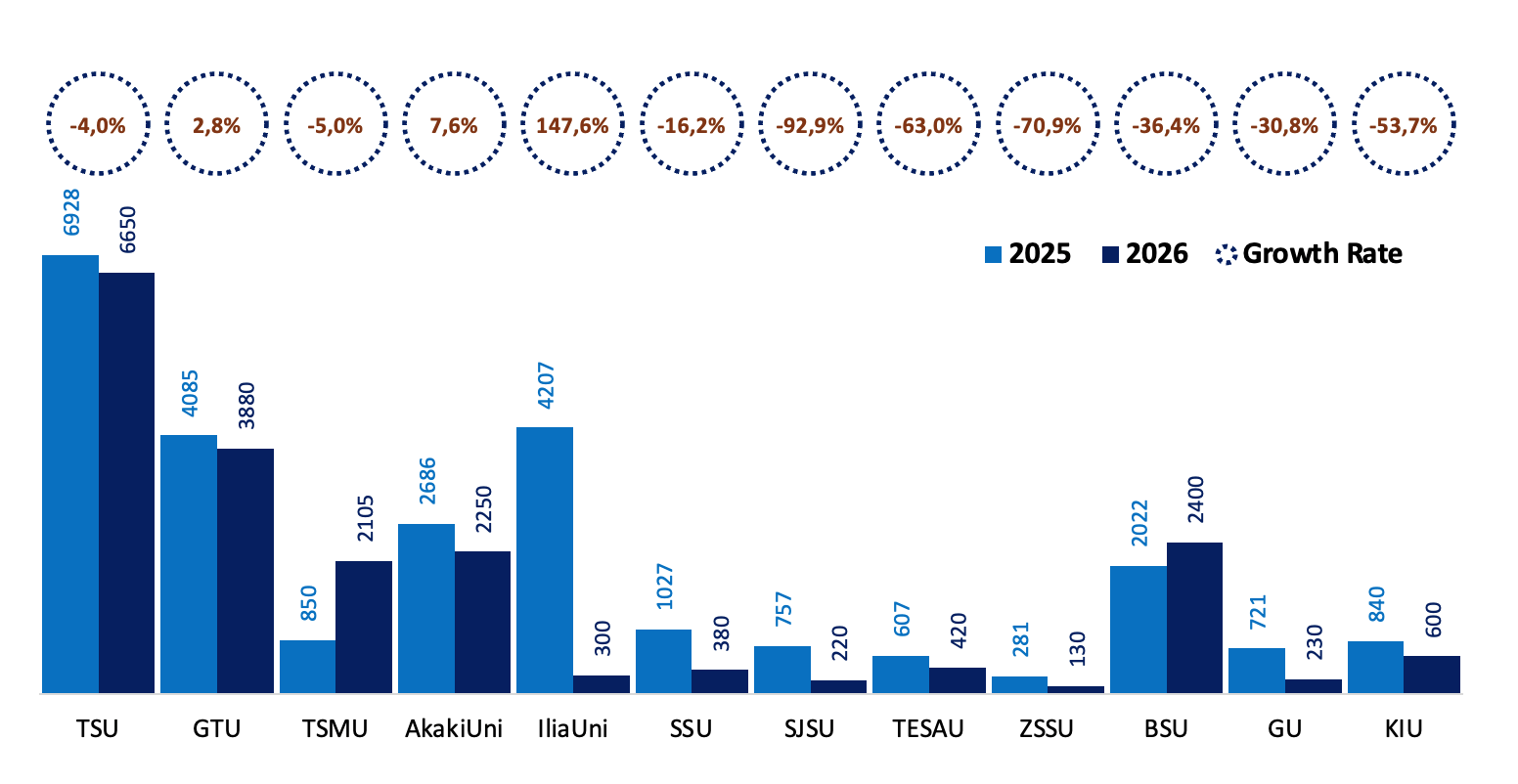
A month after these legislative changes, the Government issued Resolution N55, which established the list of approved programs and the exact number of student admissions for each state university. Overall, the total number of places at state universities is decreasing by roughly one fifth. While 27,100 places were announced across 19 public universities in 2025, this figure will fall to 21,300 in 2026 - a decrease of 21.4%.
Graph 1: Admission Places Announced at State Universities (2025-2026)
Source: Ordinance of the Government of Georgia, National Assessments and Examinations Centre, and Calculations by Egnate Shamugia, Research Fellow at Gnomon Wise.
In addition to the overall reduction, the changes have affected state universities unevenly. For example, Ilia State University will be forced to discontinue more than 90% of its programs and will only be allowed to maintain its pedagogical programs and ABET-accredited STEM programs. In numbers, this means that while the university admitted 4,207 freshmen in 2025, the number will drop to just 300 starting in 2026. Social sciences and political science programs will also be heavily affected. Starting in September 2026, the International Relations program will be offered at only three state universities: Tbilisi, Kutaisi, and Batumi. The admission quota for this program will fall from 712 to 120 places, an 83% decrease.
If the government’s goal had been to shift from voucher-based or targeted funding toward a social policy, in which public universities actively participate in decision-making instead of receiving top-down directives, then optimizing resources could have been a reasonable step. A similar approach exists in Germany, where public universities work closely with the state to resolve administrative and financial matters. In the German model, the state determines the overall level of funding and broad educational priorities, but it does not interfere in decisions about which programs universities will offer, how many students they will admit, or in which directions they will conduct research. These decisions remain part of university autonomy. For the state the quality of education at public universities is evaluated based on outcomes rather than on processes. A genuine shift in ideology direction might have been a logical reason if two conditions had been met. First, if improving the quality of education had been clearly stated as a goal in any official document: the higher education concept, the explanatory note to the legislative amendments, or the government resolution. Second, if the entire process had been transparent, allowing the public and interested parties to examine and evaluate the market research on which the new student quotas were supposedly based, according to the authors of the reform.
In a centralized management model, where the state controls both the outcomes and the processes, the accountability scheme changes. The university becomes accountable to the government rather than to the student. This creates a classic “principal-agent” problem. The government, and specifically the Ministry of Education, acts as the principal, while the administration of public universities serves as the agent, expected to pursue the principal’s goals. Previously, under the voucher or grant-based funding system, the primary source of a university’s income was the student. As a result, the annual budget of a public university depended directly on the number of students it attracted, which encouraged universities to invest resources in student recruitment and satisfaction. In the new model, excluding the student from this relationship and establishing a strict vertical hierarchy is likely to create alienation between the key parties involved: the student and the professor.
Summary
In summary, state funding and university autonomy are not mutually exclusive; accountability means being responsible for results, not controlling the process. Moreover, the state benefits from universities when they conduct teaching and research independently, free from partisan and economic influence.
The amendments to the Law on Higher Education run counter to this logic: the state simultaneously controls the budget, educational programs, student numbers, and research areas of public universities, effectively turning them into appendages of the state bureaucracy. When a university loses its autonomy, it also loses its social and intellectual value, that is, the very qualities the state once funded.
For the complete document, including relevant sources, links, and explanations, please see the attached file.