

The Impact of the Ongoing War in Iran on the South Caucasus’ Transport Corridors

illustration: GEOpolitics
In June 2025, the United States and Israel launched military strikes against Iran’s nuclear and military infrastructure. This attack marked the initial phase of the ongoing war in Iran. In February 2026, the U.S. and Israel carried out a second, significantly larger assault on Iran, turning the Middle East into the epicenter of a major conflict. As a result of the conflict, the blockage of the Strait of Hormuz and disruptions to the International North-South Transport Corridor have brought the activation of alternative transport networks to the forefront, with the South Caucasus playing a crucial role. This article analyzes the impact of the U.S.-Israel war in Iran on the transport corridors of the South Caucasus and Georgia’s position in the ongoing crisis.
Chronology of the War in Iran
The military offensive carried out by the United States and Israel against Iran represents the second major attack on the country within the past year. The first assault, known as the “12-Day War,” lasted from June 13 to June 24, 2025. During this period, Israel bombed Iran’s military and nuclear infrastructure, resulting in the deaths of high-ranking military leaders and nuclear scientists. On June 22, the United States also carried out strikes on Iran’s nuclear facilities. Despite several unsuccessful attempts to reach a ceasefire agreement, June 24 was ultimately declared as the end of the war.
Following the 12-Day War, Iran’s economic situation dramatically deteriorated, further aggravated by international sanctions imposed on Tehran in September. On September 27, the United Nations reinstated sanctions against Iran due to significant non-compliance with its nuclear obligations. The worsening economic conditions led to large-scale public protests and mass demonstrations in December 2025. The Islamic regime responded with severe repression, resulting in approximately 30,000 deaths. Parallel to these developments, the United States continued to exert maximum pressure on Iran to secure a favorable agreement regarding its nuclear program. Despite these efforts, negotiations once again failed to produce tangible results in February 2026. On February 28, 2026, the United States and Israel launched a joint attack on Iran, which resulted in the deaths of Iran’s Supreme Leader, Ayatollah Ali Khamenei, as well as several high-ranking officials of the Islamic Revolutionary Guard Corps (IRGC). In response, Iran launched attacks against Israel and U.S. military infrastructure in Persian Gulf countries, expanding the conflict across the region. By the fifth week of the war, no ceasefire agreement has been reached, and the scale of the conflict continues to grow, significantly impacting neighboring regions, including the South Caucasus.
On March 5, a drone attack on Nakhchivan Airport signaled that the war had begun to directly affect the South Caucasus. Although Iran denied involvement in the strike, Azerbaijan strongly condemned the incident and imposed temporary restrictions along its border with Iran. Additionally, Azerbaijan reported that it had prevented sabotage attempts planned by the IRGC targeting key infrastructure, including the Baku-Tbilisi-Ceyhan oil pipeline, the Israeli embassy, and the Jewish community in Azerbaijan.
The Impact of the War in Iran on the Transit Corridors of the South Caucasus
The direct impact of the ongoing war in the neighboring region has been most clearly reflected in the capacity of transit corridors in the South Caucasus. The transport route connecting Iran to the Persian Gulf via the Strait of Hormuz has been completely blocked since the very beginning of the war. Approximately 20% of the world’s oil and liquefied natural gas is transported through the Strait of Hormuz. However, since the outbreak of the conflict, cargo traffic through the strait has significantly declined. At the same time, the International North–South Transport Corridor (INSTC), a portion of which passes through Iran, has also faced major disruptions (see the image below).
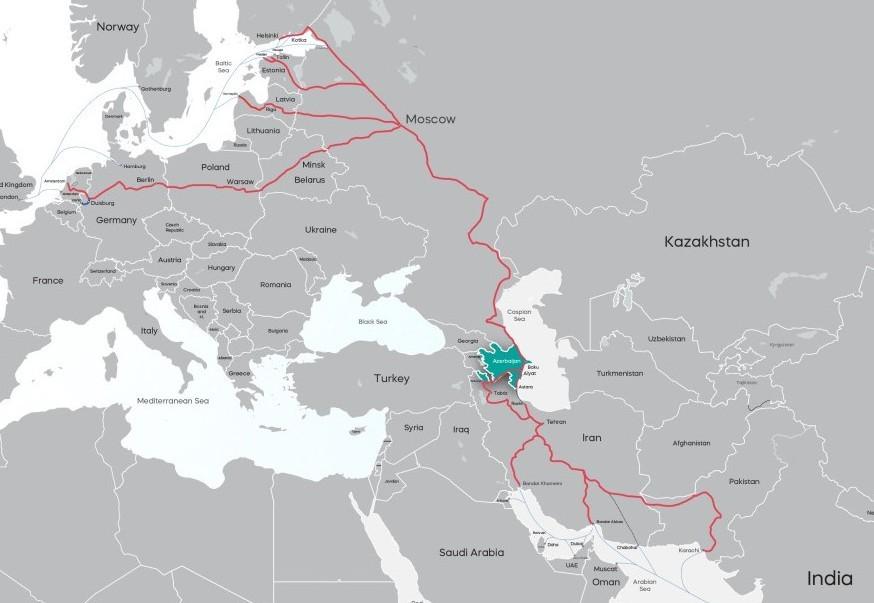
Source: The Coordinating Council of the Republic of Azerbaijan on Transit Freight
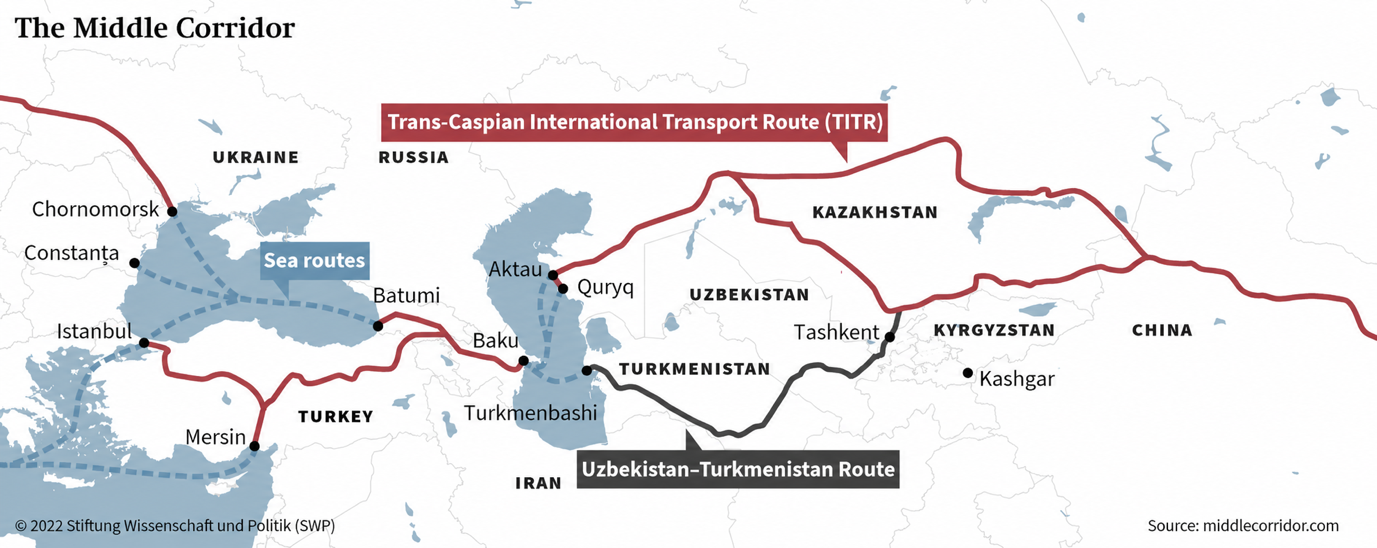
The disruption of the INSTC corridor has shifted the burden onto the so-called Middle Corridor, which connects East and West via the South Caucasus (see the image below).
Source: Stiftung Wissenschaft und Politik (SWP)
The load on this route has sharply increased since the outbreak of the war in Ukraine, and the current surge was not unexpected either. However, the ongoing war in the Middle East has further intensified pressure on its capacity. In the first week of March, traffic on the Baku-Tbilisi-Kars railway increased by 35%, resulting in kilometer-long queues of trains at border crossing points. Container transportation along the Middle Corridor has grown by 450-500% compared to the previous year. According to Richard Giragosian, Director of the Regional Studies Center in Yerevan, the crisis in the Middle East represents a window of opportunity for the South Caucasus region, since the Middle Corridor has emerged as the only reliable route for trade and transportation.
The Impact of the War in Iran on TRIPP
Assessing the impact of the ongoing war in the region on TRIPP (the Trump Route for International Peace and Prosperity) is not straightforward. The route represents a key component of the Armenia-Azerbaijan peace agreement. Any disruption in its implementation, or a loss of interest from the Trump administration, would pose a serious threat to the progress of peace processes between the parties. During the ongoing conflict, this risk has become increasingly tangible. One of the original objectives of TRIPP was to strengthen U.S. influence near Iran’s borders and to exclude Iran from transport networks connecting Central Asia with Europe.
Tehran has also opposed versions of the so-called “Zangezur Corridor” in the South Caucasus, fearing that Armenia could lose control over its southern border. Iran has further argued that such developments would effectively exclude it from Asia-Europe transport networks, as Azerbaijan would be able to connect with its western regions without transiting through Iranian territory. On March 25, 2025, during a visit to Yerevan, Iran’s Foreign Minister, Abbas Araghchi, reiterated that Iran opposes the opening of any corridor that could sever its direct transport link with Armenia. Following August 8, 2025, when it became known that the United States would become involved in the region, the minister further stated that “the development of communication networks should serve the security and economic development of regional countries, provided it is carried out within the framework of common interests, with respect for national sovereignty and territorial integrity, and without foreign interference.” Abbas Mousavi, Iran’s former ambassador to Baku and deputy head of the presidential office, described the direct involvement of Donald Trump in Armenia-Azerbaijan relations as “interesting, offensive, and dangerous.”
For decades, Azerbaijan has relied on the so-called “Aras Corridor,” passing through northern Iran, to maintain connectivity with Nakhchivan. On August 9, 2025, the following day of reaching the TRIPP agreement in Washington, Ali Akbar Velayati stated that Tehran, with or without Russia, would block a U.S.-backed transit corridor in the South Caucasus. According to him, such a corridor would “change the region’s geopolitics, redraw borders, and lead to the disintegration of Armenia.”
Based on Iran’s long-standing positions, it is evident that Tehran opposed the implementation of TRIPP even before the outbreak of the war. To better understand how the ongoing conflict and its potential outcomes may shape the future of this route, it is necessary to consider several possible scenarios.
- If the United States and Israel succeed in regime change in Iran and extend their influence over Tehran, Iran would be removed as a key opposing factor to the route. However, this would raise questions about the necessity of TRIPP itself. How beneficial would it be for the U.S. to invest in complex infrastructure across the mountainous Syunik region, stretching roughly 50 kilometers, when it could instead fully utilize Iran’s existing transport networks? That said, this argument is based on a less realistic scenario, as the establishment of a stable pro-Western regime in Iran remains unlikely in the near term. It also overlooks the fact that transit infrastructure is not only of economic value but also serves as a tool for geopolitical diversification. While the Syunik corridor may be technically challenging, it represents a foundation for stable peace in the region and increases the potential for a sustained U.S. presence in the South Caucasus, which may ultimately be of greater strategic importance to Washington.
- If the United States and Israel fail to conclude the war with regime change in Iran, Tehran will likely continue to oppose the existence of a pro-American corridor near its northern borders, thereby acting as a constraint on TRIPP’s implementation. An important question, however, is what practical leverage Iran possesses against the project. First, Tehran could destabilize the Syunik region, making the corridor unattractive to investors. Indications of such intentions have already emerged, as Azerbaijan reported thwarting sabotage attempts by the IRGC targeting its main oil pipeline. Additionally, Iran could violate its “gas-for-electricity” agreement with Armenia, thereby undermining Yerevan’s energy security. According to a July 2025 survey by the International Republican Institute, 53% of respondents in Armenia identified Iran as the country’s most important political partner, suggesting that Tehran retains significant leverage over Yerevan.
- In a third scenario, regional instability persists and the war continues without major shifts. In this case, TRIPP may not be perceived as a fully secure corridor due to its proximity to ongoing conflict. However, as noted above, it would still be significantly safer and more viable compared to transport routes passing through Iran. Consequently, investment in TRIPP as an alternative corridor could become more attractive.
As Ararat Mirzoyan, the Minister of Foreign Affairs, stated in March 2026, discussions surrounding TRIPP had not diminished. However, he also noted uncertainty regarding the feasibility of initiating construction in the second half of the year. Overall, the war in Iran creates an ambiguous environment for the TRIPP project, where geopolitical risks intersect with strategic opportunities. On the one hand, Tehran’s strong opposition, driven by fears of losing influence over Armenia and regional isolation, could escalate into direct sabotage or energy leverage, making the project less attractive for investors. On the other hand, a potential regime change in Iran could reduce the strategic necessity of TRIPP as an alternative route, particularly if U.S. access to Iran’s existing infrastructure becomes viable. Nevertheless, given that the corridor is not merely an economic project but also a strategic instrument for strengthening the U.S. influence in the South Caucasus, regional instability is unlikely to fully diminish its long-term strategic appeal; even if timelines for implementation remain uncertain.
The Increase in Georgia’s Transit Value: Passive Gains
The destabilization of Iran and the disruption of routes passing through its territory automatically increase the importance of alternative corridors that bypass Iran. While Georgia’s economy is less dependent on direct trade with Iran, it is significantly affected by changes in energy prices and transit routes. As a result of the closure of Iranian and Persian Gulf airspace, Georgia’s sky has become one of the busiest transit zones for Europe-Asia routes. However, this situation represents more of a passive gain for Georgia rather than a benefit driven by its own strategic actions.
One of the most concerning trends is Georgia’s effective exclusion from ongoing regional dialogues on transit corridors. A clear illustration of this was the visit of the U.S. Vice President J. D. Vance to Armenia and Azerbaijan, which notably did not include Georgia. Similarly, at the 2026 World Economic Forum Annual Meeting, Azerbaijani President Ilham Aliyev stated that “cargo flows between Armenia and Azerbaijan will soon follow a direct route, bypassing Georgia.” According to Irakli Kadagishvili, Chairman of the Regional Policy and Self-Government Committee, Georgia will not lose any function and “the country will not collapse” because of it. It is noteworthy, that Georgia was not represented at the 2026 Davos Economic Forum at all.
These developments point to two key issues: a lack of diplomatic engagement and a lack of a strategic vision. As noted above, the war in Iran has redirected transit flows from the Middle East toward the Middle Corridor, yet Georgia was unprepared for this shift. Following the outbreak of the war, one of Georgia’s most critical strategic priorities should have been to absorb significantly higher cargo volumes. However, the suspension of the Anaklia Deep Sea Port project has directly affected the country’s infrastructural readiness. The fact that the Anaklia port is no longer a government priority was reaffirmed during the presentation of the 2026 state budget. According to the draft, allocations for the port’s supporting infrastructure were reduced by GEL 100 million compared to the initial budget proposal, considering previous and current expenditures as well as the needs for 2026.
It is important to emphasize that the current situation is temporary. Georgia faces a classic “window of opportunity” dilemma. The main challenge lies in whether the country can transform this temporary advantage into a long-term strategic position. If Georgia fails to act proactively - through infrastructure investment, diplomatic engagement, and strategic planning - the current crisis will ultimately remain as a missed opportunity.
Finally, the telephone conversation held on March 30, 2026, between Prime Minister Irakli Kobakhidze and U.S. Secretary of State Marco Rubio has to be mentioned. According to Kobakhidze, both sides emphasized the importance of renewing the partnership and strengthening Georgia’s role as a key partner in the South Caucasus, as well as their commitment to promoting regional stability and connectivity. On the following day, Iran’s ambassador to Georgia, Ali Mojan, published a post on Facebook saying that “no country is immune from the consequences of regional crises… Those who yesterday aligned themselves with Donald Trump are now being forced to pay the price for that choice”. It remains unclear whether this statement was directly linked to the U.S. State Department’s announcement regarding the call between Rubio and Kobakhidze. However, it is evident that since the outbreak of the war, Iran has targeted, or threatened to target, transport corridors near its borders and critical infrastructure in countries allied with the United States.
Although it is not yet possible to fully assess the scope and significance of the conversation between Kobakhidze and Rubio, nor whether Georgia was implicitly referenced in the Iranian ambassador’s remarks, it is clear that the Georgian government lacks a consistent foreign policy. This has placed the country’s future prospects in a difficult position, particularly in terms of regional connectivity in the South Caucasus.
***
The large-scale conflict in Iran places the South Caucasus at a geopolitical crossroads, where the closure of traditional transit routes significantly increases the importance of the Middle Corridor and the TRIPP project. However, as this analysis demonstrates, the situation presents not only opportunities but also risks for regional actors. Iran’s threats of direct sabotage and diplomatic pressure suggest that any new infrastructure will remain vulnerable without strong security guarantees. In this context, Georgia’s position is particularly contradictory: the country benefits from so-called “passive gains” through increased air and land transit flows, yet delays in strategic projects such as the Anaklia port, along with its effective disengagement from regional dialogues, raise the risk that the current crisis will become another missed opportunity rather than a long-term advantage. Ultimately, the future of transit connectivity in the South Caucasus will depend on whether regional actors, and foremost Georgia, can respond to the new geopolitical reality shaped by Iran’s destabilization through consistent foreign policy and proactive infrastructure development.
For the complete document, including relevant sources, links, and explanations, please see the attached file.
Gallery