

Growing Subsidies for Low-Productivity Agriculture

According to the next year’s draft state budget, the government plans to increase subsidies for agriculture, a particularly inefficient sector that hinders poverty reduction, by GEL 153.8 million, bringing the planned allocation to GEL 785.2 million.
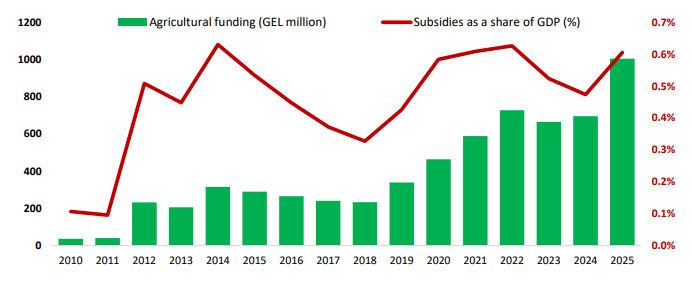
Historically, agriculture has received particularly generous budget subsidies while remaining a low-productivity sector. Over the past decade, agricultural funding has averaged 0.5% of gross domestic product, rising to 0.6% last year. In addition to financial assistance, the agricultural sector benefits from tax breaks and regulatory exemptions.
Figure 1: Budget funding for agriculture
Source: National Statistics Office of Georgia; Ministry of Finance; author’s calculations
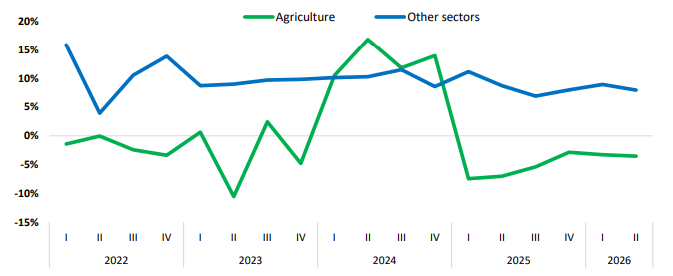
Despite this extensive support, real agricultural output has shown a clear downward trend since the first quarter of last year. In the first half of this year, real agricultural output declined by 3.4%, while the remaining sectors of the economy grew by 9.3%.
Figure 2: Real output growth (%)
Source: National Statistics Office of Georgia
Although other sectors are growing more rapidly, agriculture’s share of the economy remains high. As of 2025, agriculture accounts for 4% of global output, compared with 5.2% in Georgia. In developed countries, however, agriculture’s contribution is much smaller, 1.3% on the average. As the level of development increases, agriculture’s share of output and employment declines.
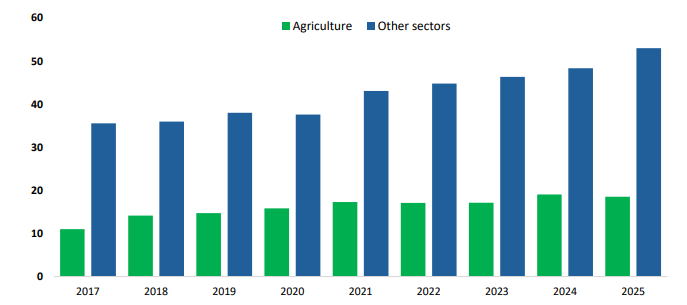
Productivity also deteriorated last year. Real output per worker fell by 2.8%. After education, agriculture is the least productive sector, with productivity approximately one-third of the aggregate level in all other sectors. Low productivity, in turn, leads to low wages.
Figure 3: Real output per worker (thousands)
Source: National Statistics Office of Georgia; author’s calculations
Average wages in agriculture are the lowest after those in education. Yet agriculture employs approximately 220,000 working-age people, or 13.6% of the total labour force. Budget subsidies keep a substantial proportion of the workforce in this inefficient sector. In practice, subsidising agriculture at the expense of the rest of the economy means sustaining low-productivity farms and keeping the rural population in poverty. Empirical research also supports this conclusion. Specifically, reallocating labour from agriculture to other sectors has a positive effect on both economic growth and national development.
Rather than improving the sector’s productivity, government subsidies contribute to its deterioration. Subsidy programmes do not require farmers to improve quality. A high-quality product will attract customers on its own and will therefore not require subsidies. On another hand, if the product is a poor-quality, it will require ongoing subsidisation. Continuous subsidies and guaranteed profits encourage farmers to put less effort into production. Thus, one of the main drawbacks of subsidies is that they weaken entrepreneurs’ incentives to produce high-quality goods for which there is market demand.
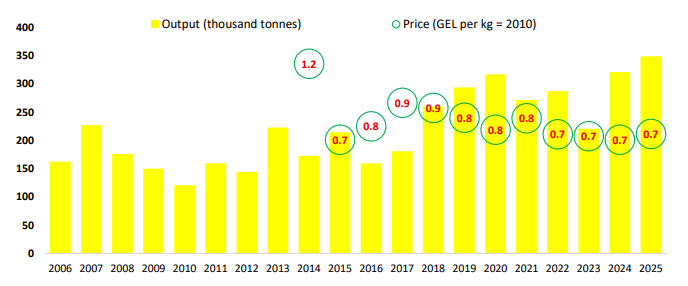
Figure 4: Grape production and real prices
Source: National Statistics Office of Georgia; author’s calculations
Viticulture stands out for the scale of the subsidies it receives, reflecting the electoral motivations of successive governments. Although difficulties in selling grapes and price trends should have led to a reduction in production, grape harvests have instead increased sharply. Generous budget subsidies have given grape growers an incentive to expand production. For example, grape production reached 348,900 tonnes last year, compared with less than half that amount -159,200 tonnes - ten years earlier. Over this period, the real farm-gate price of grapes has declined.
***
Thus, the proposed draft budget increases subsidies for low-productivity agriculture, a sector associated with poverty, by taxing successful sectors of the economy. This, in turn, causes agricultural overproduction. This long-standing practice distorts market incentives, impedes the efficient allocation of resources and, ultimately, hinders improvements in overall economic well-being.
For the complete document, including relevant sources, links, and explanations, please see the attached file.