

The Role of the Public Sector in Employment

The positive dynamics in labour market conditions observed since the pandemic reversed last year. In 2025, both the employment rate and the labour force participation rate declined. This decline is attributable to a contraction in the working-age population combined with a simultaneous exit of individuals from the labour force. Last year, the working-age population fell by 12.2 thousand, while the population outside the labour force increased by 3.6 thousand. In aggregate, the number of employed persons declined by 12.8 thousand, translating into a 0.2 percentage-point decrease in the employment rate. Last year, the employment rate stood at 46.9%, while the unemployment rate reached 13.9%.
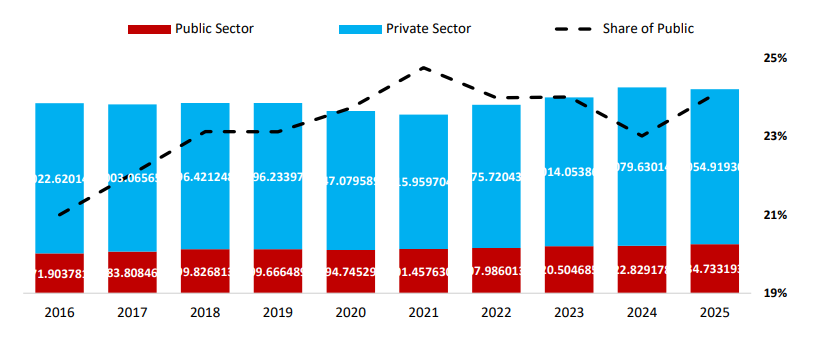
The picture of employment dynamics differs by ownership type. In the private sector, the number of employed persons declined by 24.7 thousand workers, a decrease of 2.3%, whereas over the same period, employment in the public sector increased by 3.6%. Last year, public sector employment totalled 334.7 thousand persons, accounting for 24.1% of total employment.
Figure 1: Distribution of Employed Persons by Ownership Type (thousand workers)
Source: National Statistics Office of Georgia
The government's contribution to the employment of working-age individuals has increased in the post-pandemic period. This rise in the government's contribution to the labour market since that period is the result of the annual increase in the number of persons employed in the public sector.
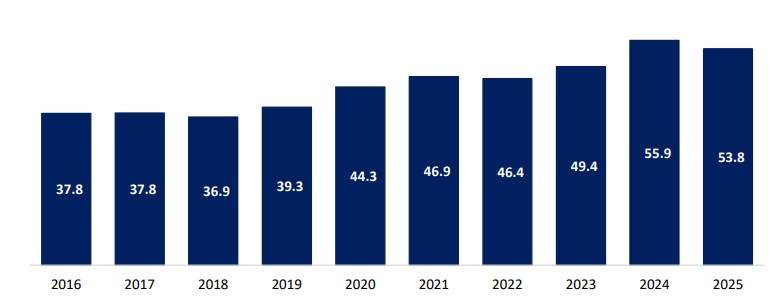
Government sector expenditure has also expanded over the same period. In recent years, alongside the growth in employment, consolidated budget real expenditure per employee has likewise increased. This implies that, following the pandemic, government real expenditure grew more rapidly than the labour resources employed to deliver such expenditure. In the post-pandemic period, the public sector has utilised less labour in the provision of goods and services; however, this figure still remains high relative to other countries. Georgia’s public sector employs more human resources than the average for a comparable set of transition economies.
Figure 2: Consolidated Budget Real Expenditure per Public Sector Employee (2010 = 100, thousands Lari)
Source: National Statistics Office of Georgia, Ministry of Finance, author's calculations
However, the dynamics observed since the pandemic period reversed last year. In 2025, the level of real expenditure per employee declined by 3.8%, which is the result of the faster pace of public sector employment growth during this period.
***
Thus, since the post-pandemic period, the government has functioned not as an encourager of employment, but as an employer in its own right. Admittedly, in the short run, growth in public employment reduces the unemployment rate; however, in the long run, such a policy crowds out private-sector activity from the marke. For instance, an empirical study based on forty years of labour market data across member countries of the Organisation for Economic Co-operation and Development found that the creation of one hundred public sector jobs by government can eliminate one hundred and fifty jobs in the private sector. Furthermore, growth in public-sector employment may reduce overall economic productivity through inefficient resource allocation. Growth in government-sector employment and real expenditure drives a reallocation of resources from the private to the public sector — from higher- to lower-productivity sectors. Accordingly, the increase in the public sector's contribution to the labour market in recent years is likely to exert a negative effect on it in the future.
For the complete document, including relevant sources, links, and explanations, please see the attached file.
Gallery